Top Sales Interview Questions & Answers for B2B Sales Reps and Managers
In B2B sales, success is rarely about charismatic pitch meetings or relying on gut feeling. Modern B2B selling is a disciplined, process-driven discipline that combines emotional intelligence, strategic deal management, structured pipeline hygiene, and effective time management.
Whether you are a B2B sales candidate preparing to demonstrate your value in an upcoming interview or a sales leader looking to hire top-tier talent who can consistently hit quota, asking and answering the right questions is crucial.
This comprehensive guide breaks down the top B2B sales interview questions across four key categories: behavioral, pipeline & process management, situational, and manager-level strategy. It provides clear candidate answer frameworks and hiring manager evaluation tips to help you stand out or build a winning sales team.
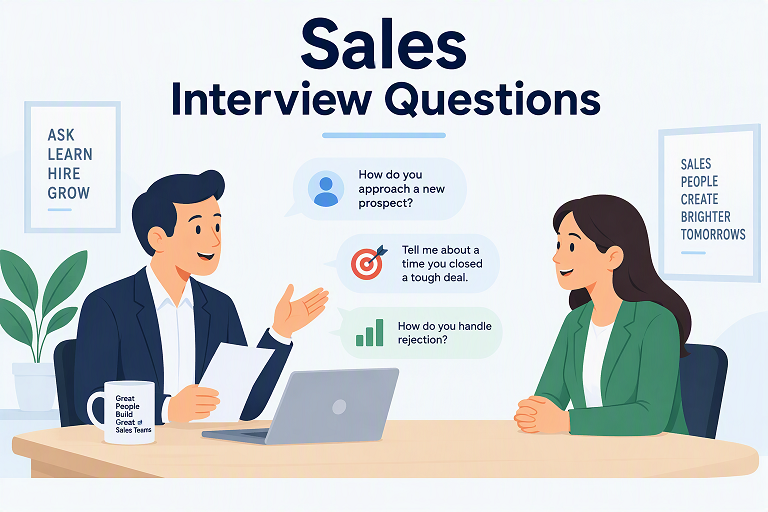
1. General & Behavioral Sales Questions
Behavioral questions allow sales leaders to assess a candidate's past performance, resilience, and personal alignment with a structured sales methodology.
Q1: "Walk me through your end-to-end B2B sales process from lead generation to deal close."
Why Hiring Managers Ask This
They want to verify if you follow a repeatable, structured methodology or simply rely on luck and unorganized outreach.
Candidate Answer Framework
Structure your answer chronologically using distinct stages:
- Prospecting & Qualification: Researching target accounts using ideal customer profiles (ICPs) and qualifying leads using frameworks like BANT (Budget, Authority, Need, Timeline) or MEDDPICC.
- Discovery: Conducting thorough discovery calls to diagnose business pain points, quantifiable impact, and technical requirements.
- Solution Presentation: Tailoring demos or proposals specifically around the validated pain points rather than giving generic feature tours.
- Objection Handling & Negotiation: Addressing procurement, pricing, or technical concerns while identifying internal champions and economic buyers.
- Closing & Onboarding: Securing contract signatures and seamlessly transitioning accounts to customer success or implementation teams.
Sample Answer Snippet: "My sales process starts with account intelligence. Once I identify ICP-fit accounts, I conduct multi-channel outreach. In the discovery phase, my goal is to uncover business consequences, not just feature interest. Throughout the cycle, I log every interaction, contact role, and deal stage in my pipeline so I can track momentum and ensure no key decision-maker is overlooked."
Manager Evaluation Tip
Look for candidates who focus on customer business outcomes rather than product features. A top candidate clearly articulates how they manage their deal stages systematically.
Q2: "Describe a time you lost a major deal. What happened, and what did you learn?"
Why Hiring Managers Ask This
This question tests self-awareness, accountability, and the ability to turn setbacks into operational growth.
Candidate Answer Framework
Use the STAR Method (Situation, Task, Action, Result):
- Situation: Briefly describe a high-stakes opportunity and its contract value.
- Task: Outline your target objective and the key stakeholders involved.
- Action: Honestly explain where the deal stalled or slipped (e.g., failing to engage the procurement team early or misidentifying the true economic buyer).
- Result: Explain the outcome and, most importantly, the key takeaway or adjustment you integrated into your deal execution strategy moving forward.
Sample Answer Snippet: "I once lost a six-figure contract late in the quarter because I relied on a single internal champion without securing direct access to the CFO. When budget cuts hit, our project was deprioritized. From that experience, I changed my approach: I now mandate multi-threading early in the opportunity stage and map out stakeholder influence early to ensure broad organizational buy-in."
Manager Evaluation Tip
Watch out for candidates who blame external factors like product gaps, pricing, or marketing lead quality. Great salespeople take ownership of their deal outcomes.
Q3: "How do you handle rejection or a prolonged sales slump?"
Why Hiring Managers Ask This
B2B sales cycles can be long and complex. Sales leaders need resilient reps who maintain high activity standards even when conversion rates temporarily drop.
Candidate Answer Framework
Focus on data-driven diagnostic steps rather than emotional reactions:
- Activity & Metric Audit: Reviewing conversion rates across email open rates, call-to-discovery ratios, and proposal acceptances.
- Pipeline Hygiene: Cleaning out dead deals to focus energy strictly on active, highly qualified leads.
- Refining the Approach: Testing new messaging variations or seeking coaching on objection handling from peers or managers.
Sample Answer Snippet: "When conversion rates dip, I go back to my data. I look at my conversion metrics across each funnel stage: prospecting outreach, discovery conversions, and proposal wins. Usually, a slump points to a specific bottleneck, like insufficient qualification at the top of the funnel. Auditing my daily activity and refining lead qualification criteria gets the pipeline back on track."
2. Process & Pipeline Management Questions
Modern B2B sales relies heavily on data integrity, routine activity tracking, and pipeline visibility. These questions evaluate how efficiently candidates manage their day-to-day workflow.
Q4: "How do you prioritize and organize your daily pipeline to ensure no lead falls through the cracks?"
Why Hiring Managers Ask This
Disorganized reps waste time switching between tasks, forget follow-ups, and let warm leads go cold.
Candidate Answer Framework
Demonstrate a clear daily routine built around structured pipeline management and task tracking:
- Tiered Prioritization: Grouping leads by deal value, buying signals, and funnel stage (e.g., prioritizing closing-stage proposals and high-intent leads first). An example of Prioritization can be like this:
- Tier 1: Closing & Proposal Stage (Immediate Action)
- Tier 2: Qualified Leads & Warm Follow-Ups
- Tier 3: New Inbound Leads & Initial Outreach
- Tier 4: Pipeline Maintenance & Administrative Updates
- Time Blocking: Setting dedicated time slots for prospecting, discovery calls, pipeline updates, and administrative follow-ups.
- Task Automation & Reminders: Setting clear task reminders and deal stage alerts to eliminate manual memory dependence.
Sample Answer Snippet: "I structure my work using a tiered prioritization model. Each morning, I start by reviewing my visual sales pipeline. I focus first on high-value deals in late negotiation stages, followed by scheduled follow-ups and inbound inquiries. By relying on task reminders and pipeline stage filters, I keep every account moving forward without relying on memory or disorganized notes."
Manager Evaluation Tip
Candidates should articulate a systematic approach to daily activity planning rather than ad-hoc, reactive execution.
Q5: "How do you maintain accurate sales forecasts and pipeline hygiene?"
Why Hiring Managers Ask This
Inaccurate pipelines distort revenue forecasting and make resource allocation difficult for management.
Candidate Answer Framework
Explain how you maintain real-time deal data and audit stage progression:
- Objective Exit Criteria: Moving deals across pipeline stages only when specific customer milestones are met (e.g., mutual action plan signed, budget verified).
- Regular Pipeline Audits: Cleaning out non-responsive contacts, updating expected close dates, and logging call notes immediately after meetings.
- Data Discipline: Treating record-keeping as a core revenue-generating habit rather than an end-of-week administrative chore.
Sample Answer Snippet: "I view pipeline hygiene as essential to accurate forecasting. I update deal stages immediately after customer interactions based on clear milestone criteria, not just optimistic feelings. Keeping clean notes, stage changes, and follow-up activities updated daily keeps forecasts reliable for executive review."
Q6: "What role does technology play in your selling process?"
Why Hiring Managers Ask This
Sales leaders want reps who use sales software to automate low-value admin tasks so they can spend more time selling.
Candidate Answer Framework
Highlight how tech tools amplify human selling efforts:
- Automating Repetitive Admin: Utilizing contact management, automated follow-up reminders, and task templates.
- Data-Driven Insights: Analyzing activity history to understand lead engagement and time-in-stage metrics.
- Focusing on Relationships: Leveraging streamlined sales tools to reserve personal energy for strategic account strategy and relationship building.
Sample Answer Snippet: "Technology should eliminate busywork. By setting up automated tasks and structured deal pipelines, I spend less time manually updating spreadsheets and more time building relationships. Good tools serve as an operational command center, ensuring fast follow-up times and predictable lead flow."
Q7: "How do you manage short-term sales targets alongside long-term enterprise pipeline development?"
Why Hiring Managers Ask This
Reps often focus exclusively on immediate targets, resulting in empty pipelines in subsequent quarters ("rollercoaster revenue").
Candidate Answer Framework
Explain your method for balancing deal sizes and sales cycles:
- Pipeline Mix: Maintaining a balanced mix of transactional (short sales cycle) and strategic (longer sales cycle) accounts.
- Consistent Daily Prospecting: Reserving non-negotiable weekly hours for outbound prospecting regardless of current quarter status.
- Stage Tracking: Monitoring time-in-stage metrics to ensure future-quarter deals move forward at a steady pace.
Sample Answer Snippet: "I prevent revenue dips by maintaining a balanced pipeline mix. I allocate roughly 60% of my active pipeline to mid-market deals that close within standard cycles, while dedicating 40% to larger strategic accounts. Consistent daily prospecting logged directly into my system ensures that while I close current deals, the top of the funnel stays healthy for upcoming quarters."
3. Situational & Role-Play Questions
Situational questions evaluate how candidates handle real-world challenges during discovery and negotiation.
Q8: "A prospect tells you: 'Your product looks good, but your competitor is 30% cheaper.' How do you respond?"
Why Hiring Managers Ask This
This tests your value-based selling capability and your ability to defend pricing without immediately offering discounts.
Candidate Answer Framework
Follow a 4-step framework: Acknowledge -> Clarify -> Reframe Value -> Validate ROI
- Acknowledge: Validate their focus on cost without becoming defensive.
- Clarify: Ask open-ended discovery questions to uncover what specific functionality or service levels the lower price includes.
- Reframe Value: Highlight total cost of ownership (TCO), business outcomes, customer support, and implementation speed.
- Validate ROI: Anchor the price difference to measurable savings, productivity gains, or risk mitigation.
Sample Answer Snippet: "I appreciate budget efficiency is a priority. Often, initial price differences come down to scope and operational hidden costs. I would ask: 'To ensure a fair comparison, are they including ongoing onboarding support, workflow customization, and full feature access?' Then, I shift the focus from upfront price to overall ROI, demonstrating how our solution reduces operational drag and drives faster time-to-value."
Manager Evaluation Tip
Avoid candidates whose immediate instinct is to offer a discount. Look for reps who confidently defend product value and ROI.
Q9: "You are mid-way through a sales cycle, and your main point of contact suddenly stops responding. What is your playbook?"
Why Hiring Managers Ask This
Unresponsive prospects happen often. Reps need a deliberate, multi-channel re-engagement plan rather than sending repetitive "just checking in" emails.
Candidate Answer Framework
Outline a structured, multi-channel re-engagement approach:
- Value-Add Follow-Ups: Share relevant industry reports, case studies, or feature updates instead of generic check-ins.
- Multi-Threading: Reach out to secondary contacts or higher-level executives with a fresh perspective.
- Channel Switching: Shift communication channels from email to phone, LinkedIn, or video messages.
- The 'Break-Up' Email: Send a polite, professional break-up email to prompt a final decision or response.
Sample Answer Snippet: "First, I review past interaction logs to identify any missed signals or unresolved concerns. Next, I switch from generic check-ins to value-focused touches: sharing a case study or industry benchmark relevant to their team. If silence continues, I multi-thread by reaching out to another team member involved in initial discussions. Finally, I use a courteous break-up email, which frequently prompts a quick response."
Q10: "How do you handle a scenario where a prospect requests a critical feature that your product does not currently offer?"
Why Hiring Managers Ask This
This evaluates honesty, resourcefulness, and the ability to distinguish between essential deal-breakers and secondary feature preferences.
Candidate Answer Framework
- Uncover the Underlying Need: Ask why the feature is required to understand the core workflow problem.
- Identify Workarounds: Determine if existing product capability or third-party integrations can solve the core issue.
- Be Transparent: Be honest about current product limits without making false promises.
- Assess Deal Impact: Confirm whether the missing feature is a true deal-breaker or simply a nice-to-have item.
Sample Answer Snippet: "I dig into the 'why' behind the request. Often, prospects ask for a specific feature because they are used to an old process. By understanding their underlying goal, I can often show how our existing workflows or integrations achieve the exact same outcome. If it is a true gap, I am transparent about our product roadmap rather than making false promises."
4. Sales Manager & Strategy Questions
Sales management questions evaluate leadership, team coaching, pipeline inspection, and operational consistency.
Q11: "How do you evaluate whether a sales rep's pipeline is real or filled with inflated 'ghost' deals?"
Why Hiring Managers Ask This
Sales leaders need managers who rigorously inspect pipeline quality to ensure reliable executive reporting.
Candidate Answer Framework
Focus on objective pipeline inspection metrics:
- Stage Duration Audits: Identifying deals stuck in a single stage significantly longer than the average sales cycle.
- Mutual Action Plan Verification: Checking for clear next steps, confirmed budgets, and logged stakeholder interactions.
- Activity Ratios: Comparing logged call/email activity against stated deal stage progress.
Sample Answer Snippet: "I inspect pipelines using objective activity indicators rather than rep optimism. I audit time-in-stage metrics, confirmed meeting logs, and written next steps. If a deal has been in 'Proposal Sent' for 45 days with zero logged activities, it is not a real opportunity. Clean pipeline visibility makes it easy for managers to spot stalled deals early and keep forecasts accurate."
Q12: "How do you coach an underperforming sales representative back to quota consistency?"
Why Hiring Managers Ask This
Effective sales leadership requires diagnosis, actionable coaching, and structured accountability.
Candidate Answer Framework
Outline a clear, metric-driven coaching framework:
- Root Cause Diagnosis: Analyze funnel data to pinpoint the exact conversion bottleneck (prospecting volume, discovery quality, or closing ability).
- Targeted Skill Building: Conduct call reviews, role-play objection handling, and shadow live discovery sessions.
- Actionable 30-Day Plan: Set clear, weekly activity and output milestones.
- Regular Accountability: Review progress during weekly 1-on-1 meetings using activity dashboards.
Sample Answer Snippet: "I start with data. By evaluating funnel conversion metrics, I can isolate whether the issue is top-of-funnel volume, poor discovery qualification, or weak closing. Once identified, we build a 30-day action plan focused on measurable activity goals and weekly call reviews to track improvement step-by-step."
Q13: "What metrics do you track daily and weekly to measure sales team health?"
Why Hiring Managers Ask This
This question tests whether a manager understands both leading indicators (activities) and lagging indicators (revenue output).
Candidate Answer Framework
Divide your answer into leading and lagging operational metrics:
- Leading Indicators (Activity & Engagement): Outbound calls/emails logged, discovery calls completed, new opportunities created, and pipeline stage movements.
- Lagging Indicators (Results): Closed-won revenue, average deal size, win rates, and length of sales cycle.
Sample Answer Snippet: "I balance leading and lagging indicators. Lagging indicators like closed-won revenue show past performance, but leading indicators such as new opportunities generated, discovery calls completed, and pipeline stage movement predict future revenue. Tracking these metrics daily allows me to catch activity gaps weeks before they impact quarterly targets."
Cheat Sheet: Comparing Candidate Answers
Use this quick summary table during interview prep or candidate evaluation:
| Question Category | Weak Answer Sign | Winning B2B Answer Sign |
|---|---|---|
| B2B Sales Process | Vague, reactive, relying purely on "pitching skill" or intuition. | Structured, multi-stage methodology grounded in qualification frameworks (BANT/MEDDPICC) and clean data. |
| Pipeline Management | Informal tracking, relying on memory, spreadsheets, or post-it notes. | Systematic daily prioritization, clear stage exit criteria, and routine pipeline updates. |
| Pricing Objections | Offering instant discounts or becoming defensive about cost. | Defending ROI, clarifying competitor scope, and reframing total cost of ownership. |
| Sales Management | Relying strictly on end-of-month revenue outcomes to evaluate reps. | Managing through leading activity metrics, auditing time-in-stage data, and structured coaching. |
Conclusion: Turning Process into Sales Success
Mastering B2B sales whether as an individual account executive or a sales manager requires combining proven communication skills with disciplined process execution.
When candidates demonstrate clear qualification habits, thoughtful objection handling, and strong pipeline hygiene, they prove they are equipped to achieve predictable revenue performance.
For sales teams looking to streamline this execution, having lightweight, easy-to-use software makes all the difference. Tools like ToolsOnCloud CRM provide sales professionals with a clean platform to organize leads, automate follow-up tasks, and track pipelines efficiently, ensuring reps can focus on building relationships and closing deals.
Follow us on social media




💡 Innovate Your Sales Process
Organize your leads and close Deals faster.
Get the best Small Business CRM for Free
Try ToolsonCloud CRM Today!